
Kentro Connection
Faith, Help & Lasting Hope: A Collection of Kentro Stories
A collection of stories from Kentro members collaborating to host our medical missions conference this October.
Canadian Christians feel many things about poverty, but hopeful may not be one of them. In a recent survey we completed, we found that only 7% of respondents felt hopeful in regards to the work done to alleviate poverty.
With The World Bank estimating that roughly 833 million people continue to live below the international poverty line and the UN estimates that approximately 733 million people experienced hunger in 2024, it is understandable why hope may be hard. This lack of hope is likely due to something else the survey revealed: 2 out of 5 people – most of whom are already donating to a poverty charity – feel unsure how to respond in ways that are wise and truly helpful.
Kentro wants to help with this uncertainty. We know the organizations that can equip Canadian Christians in many ways (beyond donating!) to truly make a difference – inspiring hope internationally, and right here at home in Canada.
In our recent newsletter, we’ve chosen to feature one of the things that Kentro is doing to help Canadian Christians feel more hopeful about global poverty, and creative about how they can get involved: hosting Health for All Nations, Canada’s first medical missions conference.
After you’ve read the stories below, we invite you to take one small action. If you are a medical professional, we warmly invite you to attend Health for All Nations.
If you are not a medical professional, we invite you to pursue hope in a different way – connect with a Kentro member about ways that you could go beyond donating (you can see our member list here) or take a moment to share with someone in your community why you believe it is important to care for the poor.
*Note that names in the stories below have been changed to protect privacy.
Story 1: Returning Home to Multiply Hope, From BethanyKids
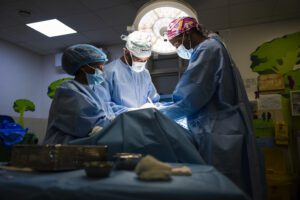 Growing up in Ethiopia, Dr. Muse knew firsthand the challenges families face when specialized surgical care for children is unavailable close to home. During medical school, he met a BethanyKids-trained pediatric surgeon whose example convinced him that he too could pursue pediatric surgery and help close that gap for children across Africa.
As he trained alongside graduates of the Paediatric Acute and Critical Care Surgery program, Dr. Muse became increasingly convinced that the solution to Africa’s shortage of pediatric surgeons was clear: train and resource surgeons from Africa who continue to serve in Africa.
In time, Dr. Muse joined BethanyKids for pediatric surgery training and quickly discovered an experience that exceeded his expectations. Alongside outstanding surgical education, he received discipleship, leadership development, and mentorship that shaped him both professionally and personally.
Fast forward to today, Dr. Muse is returning home to Ethiopia carrying much more than surgical skills. He returns with a vision to train others, mentor future surgeons, and build systems of care that will serve children for generations to come. He hopes to share both compassionate surgical care and the love of Jesus with children and families across Ethiopia.
Story 2: Clubfoot: How Training Shaped Two Brothers’ Futures, From Mercy Ships
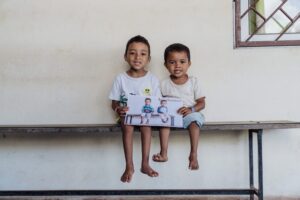
Brothers: Fanirisoa and Vonjy
Photo credit: Mercy Ships
On a warm morning at Hôpital Analakininina in Toamasina, Madagascar, five-year-old Fanirisoa and his younger brother, three-year-old Vonjy, sit close to their mother, laughing and nudging each other despite the medical setting.
Both boys were born with clubfoot, a condition that twists the feet inward, making it painful to walk, run, or play. Traditional remedies brought little relief, and their father, Edmine, remembers the pain: “Before, walking was painful for them. They used to cry and say, ‘It hurts.'”
The family traveled more than eight hours in search of care and found it through the Africa Mercy®. Remarkably, Vonjy’s case needed no outside help at all — he was treated entirely by Malagasy clinicians trained a decade earlier through Mercy Ships’ first clubfoot mentoring program. “More than 3,000 children… have been treated and healed from clubfoot since then,” said Dr. Saholy Razafindranaly, a local Ponseti trainer.
Fanirisoa’s case was more complex, part of a renewed mentoring effort training local teams to treat older children. Weeks of casting, a small surgery, and careful follow-up restored his mobility — and doubled as hands-on training for Malagasy clinicians.
“Now their feet are straight, and they can walk normally,” Edmine said. “Their feet are just like everyone else’s.”
Orthopedic surgeon Dr. Rachel Buckingham summed up the goal: to strengthen local training “so that, one day, Mercy Ships is no longer needed.”
When knowledge is shared, healing does not end; it is multiplied.
Story 3: Bringing Health Home in Rural Ghana: Adwoa’s Story, By Jackie Cousins, Health Partners International Canada
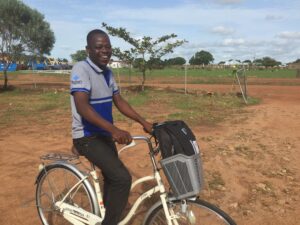
HOPE community health worker with a bike. Photo credit: HPIC
In Ghana’s Upper East Region, the nearest health facility can be over two hours away on foot—a distance that can mean life or death for young families.
HPIC’s flagship HOPE project, in collaboration with its long-time community partner in Ghana, trains community-nominated health workers to deliver care directly to mothers and children under five in remote areas.
When Adwoa’s two-year-old son Kwaku developed a high fever and diarrhea, the single mother of four turned to Mr. Joseph, a local HPIC-supported community health worker. He tested Kwaku for malaria, provided medicine, and trained Adwoa to administer treatment at home.
“The following day, his temperature had reduced and he was in better spirits. Mr. Joseph continued to visit us until my son fully recovered,”
Equipped with a bike, a backpack of supplies, and life-saving medicines, health workers like Mr. Joseph detect and treat common childhood illnesses—pneumonia, diarrhea, and malaria—before they become emergencies. Time is critical: rapid diagnostic tests provide quick results and are simple to perform and interpret.
Without this service, the outcome could have been very different. “I wonder what would have happened to my son without this free treatment from a community-based health worker who devotes their time to help families like mine. I say thanks to HPIC and their partner for helping my son and all of my community” shared Adwoa.
Story 4: Life-Saving Surgeries in Zimbabwe, By Samaritan’s Purse Canada
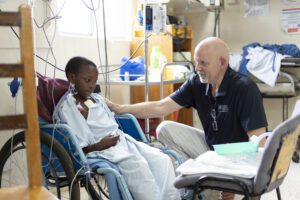
Robert Groom, Perfusionist – WMM Short Term Volunteer, photo credit: Samaritan’s Purse
Lights shine brightly in an operating theater at Karanda Mission Hospital in Zimbabwe. Dr. Mark Lane-Smith carefully repairs an inguinal hernia threatening the life of 2-month-old Mufaro.
Dr. Mark, a general surgeon from Orangeville, Ontario, has served at Karanda on four separate month-long trips—three of which have been with World Medical Mission.
This ministry of Samaritan’s Purse places volunteer evangelical Christian medical professionals in short-term service worldwide. In over 30 countries, their mandate is to “heal the sick there, and say to them, ‘The kingdom of God has come near to you’” (Luke 10:9).
“One man brought his 10-year-old son Anesu from three hours away with an ultrasound report in hand from the prior day confirming acute appendicitis,” shared Dr. Mark. “He was convinced his child would get better and more timely care.” After prayer, Anesu’s surgery at Karanda set him on the road to recovery.
Prayer is standard practice before every surgery at Karanda. Alongside the hard-working Zimbabwean staff, “it’s wonderful to have the freedom to pray with patients and speak with them about spiritual matters,” Dr. Mark said.
Though medical missions can have challenges, “the richness of relationships, the freedom to pray and share Christ, as well as the natural beauty and cultural experience more than make up for the challenges,” Dr. Mark declared.

Collaboration is at the center
Organizations can’t fight poverty on their own. Get connected. We are stronger together.